Sizing KAS Capacity Around a 0.05 BTC Goal
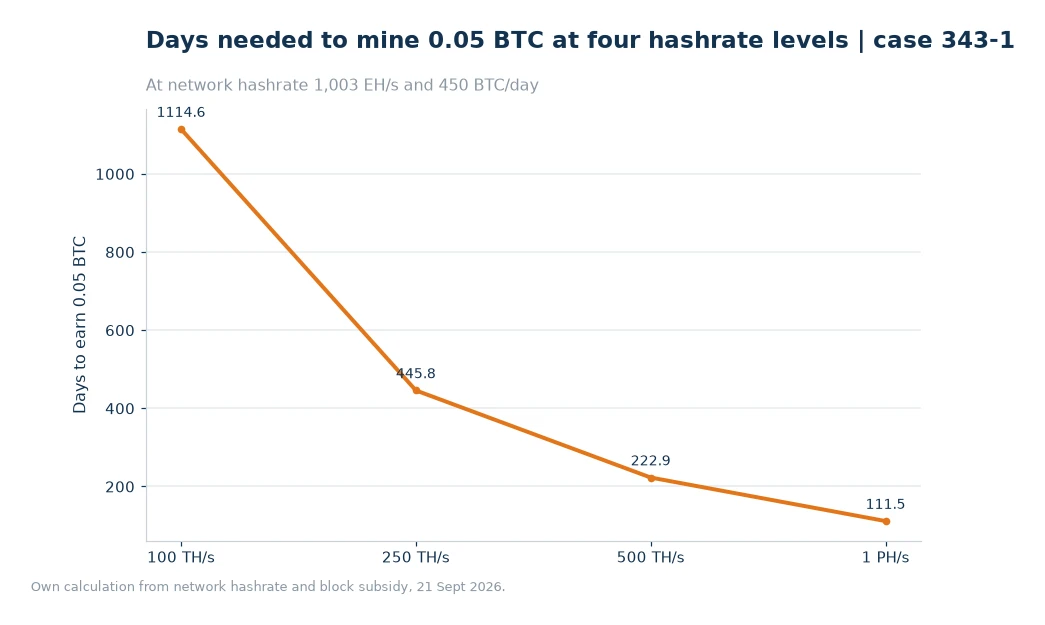
Fifty thousandths of a Bitcoin is $4,234.60 at $84,692. Reaching it takes 1,114.6 days at 100 TH/s and 111.5 days at 1 PH/s, so the purchase decision is really a decision about which calendar you can live with. The KAS price sits on top of that choice rather than inside it.

Key takeaways
- 0.05 BTC needs 1,114.6 days at 100 TH/s, 445.8 at 250 TH/s and 111.5 at 1 PH/s.
- That is 3.05 years at the smallest size and 0.31 years at the largest, a tenfold difference in calendar exposure.
- Electricity for the whole window lands near $3,210 at either end, because energy per coin does not fall with hashrate.
- A 2.12% difficulty decline, if it arrives, trims roughly 23 days from the 100 TH/s schedule.
A larger goal does not scale with the budget
Moving from 0.005 BTC to 0.05 BTC multiplies the required work by ten. Budgets rarely multiply by ten at the same moment, so the usual result is a plan that keeps the old hashrate and quietly accepts a longer horizon. That is not a failure of discipline; it is what happens when a target is chosen in coins and a machine is chosen in dollars without the two being reconciled.
The reconciliation is simple enough to do before a purchase order exists. Divide the target by the daily output of each candidate capacity, convert the answer into years, and compare that number with the life of the hardware, the length of the power agreement and the patience of whoever is funding it. Three numbers, one decision.
Most operators do this backwards. They start with a machine they like, work out what it earns, and then choose the target that the machine can plausibly hit. That route is comfortable and it hides the real trade: the target is the requirement, and the machine is one of several ways to meet it. Reversing the order takes twenty minutes and usually changes the shortlist.
Plan in years, because the calendar is the purchase
Hardware is usually sold on a two- or three-year assumption about its useful life. A schedule that needs 3.05 years at 100 TH/s therefore runs past the point where the machine is likely to be the same machine: fans, boards and power supplies age, and efficiency improves elsewhere in the market while yours stands still. The target may still be reached, but with a repair budget attached.
At 250 TH/s the horizon drops to 1.22 years, which fits comfortably inside a normal hardware life and leaves room for one difficulty cycle. At 500 TH/s it is 0.61 years, short enough that the purchase behaves more like a project than an asset. Those are different financial objects even though they mine the same coin, and they deserve different approval questions.
One practical rule: if the schedule is longer than the warranty, price the replacement risk into the decision before comparing the two options on sticker cost. A machine that reaches the goal in year three with a failed board in year two has not reached it on the original budget.
There is also an opportunity cost hiding in the long schedule. Capital committed to a three-year mining plan cannot be used for anything else during those years, and the comparison should be made against whatever else that money would have done — including simply holding the Bitcoin the plan is trying to mine. A short schedule is worth a premium precisely because it returns the capital sooner.
KAS income and the estimate that shifts the date
KAS is what the rig actually earns, at $0.04130647 on 21 Sept 2026, and the conversion to BTC is a separate step with its own price. For planning purposes the cleanest approach is to keep the coin leg and the Bitcoin target in separate columns and to convert at a rate you are willing to defend, rather than at the rate that makes the schedule look good.
The ViaBTC KAS Mining Pool dashboard shows the coin-side output, and it is worth checking against your own count of shares once a week for the first month. Disagreements are usually a configuration issue rather than a payout issue, and finding one early is cheaper than finding it after a quarter.
Bitcoin difficulty is the input that moves the finish line without any action from you. The estimate read on 21 Sept 2026 pointed to a 2.12% decline at the next adjustment. Apply that to the 100 TH/s schedule and 1,114.6 days becomes about 1,091, a saving of roughly 23 days. It is a small saving, it may not arrive, and it will be reversed by the next upward adjustment — but it shows how sensitive a three-year plan is to an input nobody controls.
Four capacities at one finish line
The table keeps the target fixed at 0.05 BTC and varies only the capacity. The years column is the one to read first; the daily column explains why the years move the way they do.
Power draw is included because it changes the shape of the comparison. A larger capacity reaches the goal sooner but draws proportionally more, so the energy bill for the entire window is almost identical at both ends of the table. What you buy with more hashrate is time, not efficiency.
| Capacity | Daily BTC | Days to 0.05 BTC | Years | Draw at 20 J/TH |
|---|---|---|---|---|
| 100 TH/s | 0.00004486 | 1,114.6 | 3.05 | 2 kW |
| 250 TH/s | 0.00011216 | 445.8 | 1.22 | 5 kW |
| 500 TH/s | 0.00022432 | 222.9 | 0.61 | 10 kW |
| 1 PH/s | 0.00044865 | 111.5 | 0.31 | 20 kW |
Worked example
Run the smallest option end to end, then repeat the cost line at the largest. The two should land in the same place, and that is the lesson.
- Daily BTC per TH/s: 450 ÷ 1,003,000,000 = 0.00000044865.
- 100 TH/s: 100 × 0.00000044865 = 0.00004486 BTC a day.
- Days: 0.05 ÷ 0.00004486 = 1,114.6.
- Years: 1,114.6 ÷ 365 = 3.05.
- Dollar value: 0.05 × 84,692 = $4,234.60.
- Power: 100 × 20 = 2,000 W, so 48 kWh a day; at $0.06 that is $2.88, and over 1,114.6 days it is $3,210.05.
- At 1 PH/s: 20 kW gives 480 kWh a day and $28.80; over 111.5 days that is $3,211.20.
- Margin at either size: 4,234.60 − 3,210 ≈ $1,024 before the fee adjustment and before hardware.
The near-identical energy totals are not a coincidence. Energy per coin is set by the network's energy per coin, and your share of it scales with your share of hashrate. A bigger machine shortens the period over which you pay, but it does not pay a lower rate per unit of output. Anyone who expects a tenfold hashrate to produce a tenfold margin is reading the daily line and skipping the cost line.
Frequently asked questions
How much hashrate do I need for 0.05 BTC?
It depends on the deadline. At 100 TH/s the target takes 1,114.6 days, at 250 TH/s it takes 445.8 days and at 1 PH/s it takes 111.5 days, all at a network hashrate of 1,003 EH/s.
Does a bigger machine improve the energy cost per coin?
No. At 20 J/TH the 100 TH/s option spends about $3,210 on power over 1,114.6 days and the 1 PH/s option spends about $3,211 over 111.5 days, so the larger unit buys time rather than a cheaper coin.
What happens to the plan if difficulty falls?
A 2.12% decline, the estimate read on 21 Sept 2026, would shorten the 100 TH/s schedule from 1,114.6 days to about 1,091 days; the effect is small and can reverse at the following adjustment.
Choose the horizon before the hashrate
Decide how many years you are willing to wait, then read the table backwards to find the capacity that fits. A three-year horizon points at the small end and a six-month horizon points at the large end, and the energy cost of the two is nearly the same. What differs is how much capital sits at risk for how long, and that is a question about your balance sheet rather than about the network. The Collateral-Pledged Loans option and the Miner Profitability Ranking are both worth a look before committing, since one prices liquidity and the other prices the machines.
Sources: the ViaBTC pool, tools and finance pages for KAS settlement, hardware rankings and the listed 4%[1]. Chain inputs read 21 Sept 2026: network hashrate 1,003 EH/s, difficulty 132.76 T, subsidy 3.125 BTC per block, 144 blocks a day, BTC $84,692, KAS $0.04130647, next difficulty estimate −2.12%. Published 24 Oct 2026. Power assumes 20 J/TH at $0.06 per kWh and continuous uptime.