Jackets and Headspace: Tank Design Details That Show Up in the Beer
Two fermentation tanks of the same volume can behave like different machines, because the details that decide how a tank cools and how it foams are hidden in the jacket layout and the cover headspace. HGMC publishes both: specially designed jackets on the body and the cone, and a cover headspace volume calculated separately.
Key takeaways
- Jackets on both the body and the cone let the whole vessel move temperature together, including the cone where the yeast settles.
- Cover headspace is published as a separately calculated volume, so krausen has room instead of pushing through the CIP arm on the most active batch.
- The published fabrication standard is TIG 100% full welding joints, polishing accuracy of 0.4 micrometres or better, and stainless steel 304 or 316 in 3 mm and 2 mm plate.
- The design is published as handling beer up to 33 Plato, with piping laid out to avoid wort aeration and mash, wort and water flow controlled automatically.
Why the Jacket Layout Sets the Cooling Curve
Cooling a fermenter is not one job but two: pulling heat out of the bulk liquid during an active ferment, and holding a steady temperature once the beer has calmed down. A jacket wrapped around the body does the first job well, because most of the volume is there. The cone is where the work is different, since the yeast settles there and a cone that stays warm keeps fermenting after the beer above it has finished.
That is why the published design specifies specially designed jackets on both the body and the cone rather than a single shell jacket. The practical difference appears at crash cooling: with jackets top and bottom, the temperature gradient through the tank is smaller, the yeast drops out more predictably, and the pump, the chiller and the glycol loop are not fighting a warm pocket at the bottom of the vessel.
Headspace Is Calculated, Not Left Over
Headspace is the most commonly underestimated number on a fermentation tank, because it looks like wasted volume on a price list. Krausen from a vigorous ferment can occupy a fifth or more of a vessel, and a tank filled to the brim pushes foam out of the top, through the CIP arm, and onto the floor where it is both a loss and a slip hazard. Calculating the cover headspace as its own volume, as this manufacturer does, is the difference between a design decision and an accident.
The published advantage is described as a bigger headspace, with the cover headspace volume calculated separately from the working volume. Read together with the published claim that the design handles beer up to 33 Plato, the logic is straightforward: a stronger wort ferments harder, and the more concentrated the brew, the more room the foam needs. Buyers who ask for the headspace figure in litres before signing tend to be the ones who never mop a fermenter floor.
Welds, Polish and Plate Thickness
Inside a tank, cleanliness is geometry. HGMC publishes TIG 100% full welding joints, polishing accuracy of 0.4 micrometres or better, and stainless steel 304 or 316 plate in 3 mm and 2 mm thicknesses, with SUS304 food-grade material certified by SGS. Weld quality and surface finish decide whether a cleaning cycle leaves a film behind, which is why a spec sheet that names the polishing standard is more useful than one that only names the steel.
Plate thickness is the honest trade in the same list. Thicker plate resists deformation during pressure testing and takes more abuse from a forklift; thinner plate keeps a small vessel affordable and is entirely adequate for low-pressure service, where the vessel is rated for the duty rather than for a bigger tank it is not. A buyer comparing two quotes should compare the thicknesses before deciding which vessel is the bargain.
Aeration, Flow and the Control Layer
Cold beer is fragile in the presence of oxygen, and most of the oxygen a brewery can avoid is avoided in the piping rather than in the tank. The published design lays out the piping to avoid wort aeration, which shows up later as a flavour that goes flat and stale sooner than the same beer from a neighbour. It is a design decision with no visible hardware, which is why it rarely appears in a comparison spreadsheet.
The control layer is the last detail and the most quotable. HGMC publishes three levels: a PID display control panel, a PLC semi-automatic touch screen, and a PLC fully automatic control panel with curve indication and production-record printing, alongside fully automatic mash, wort and water flow with automatic temperature control and a well-designed steam system. Any shortlist ends up comparing the same variables, and Beer Brewing Equipment Manufacturers publish them in a form a brewer can check against a batch record.
| Tank detail | Published specification | What it changes |
|---|---|---|
| Jacket layout | Specially designed jackets on both the body and the cone | Whether the cone cools with the shell, and how predictably the yeast drops out |
| Cover headspace | Headspace volume calculated separately, described as a bigger headspace | Whether an active ferment stays in the tank or leaves through the CIP arm |
| Welds and polish | TIG 100% full welding joints; polishing accuracy 0.4 micrometres or better | Whether the surfaces and joints are cleanable batch after batch |
| Plate and grade | Stainless steel 304 or 316, 3 mm and 2 mm plate; SUS304 food grade certified by SGS | Duty, deformation resistance and the price you pay for the wall |
| Piping design | Piping laid out to avoid wort aeration | How long the packaged beer holds its flavour before it turns stale |
| Control level | PID panel, PLC semi-automatic touch screen, or PLC fully automatic with curve indication and production-record printing | Repeatability between shifts and the paperwork behind a batch record |
Worked example
The numbers below are a worked example using the published design rule that cover headspace is calculated separately, not a specification for any particular tank. Assumptions: a 10 BBL fermentation tank, 1 BBL taken as 117 L, and a target fill of 80% of vessel volume for an ordinary ale.
Tank volume first: 10 BBL x 117 L = 1,170 L, which is close enough to the published 10 BBL landmark of roughly 1,174 L. Filling to 80% puts 1,174 x 0.8 = 939 L of wort in the vessel and leaves 235 L of cover headspace. Filling to 75% puts 880 L in and leaves 294 L of room. The second choice costs 59 L of capacity per tank and buys a bigger margin for the most active day of the ferment.
Multiply that across a tank farm and the trade becomes visible. Four fermentation tanks filled to 80% hold 4 x 939 = 3,756 L of working beer; filled to 75% they hold 4 x 880 = 3,520 L, a difference of 236 L per generation, or about 2,010 L across the 8.5 generations a year that a 14-day residency allows. Losing that volume costs less than losing a batch to an overflow that also floods the cold room floor.
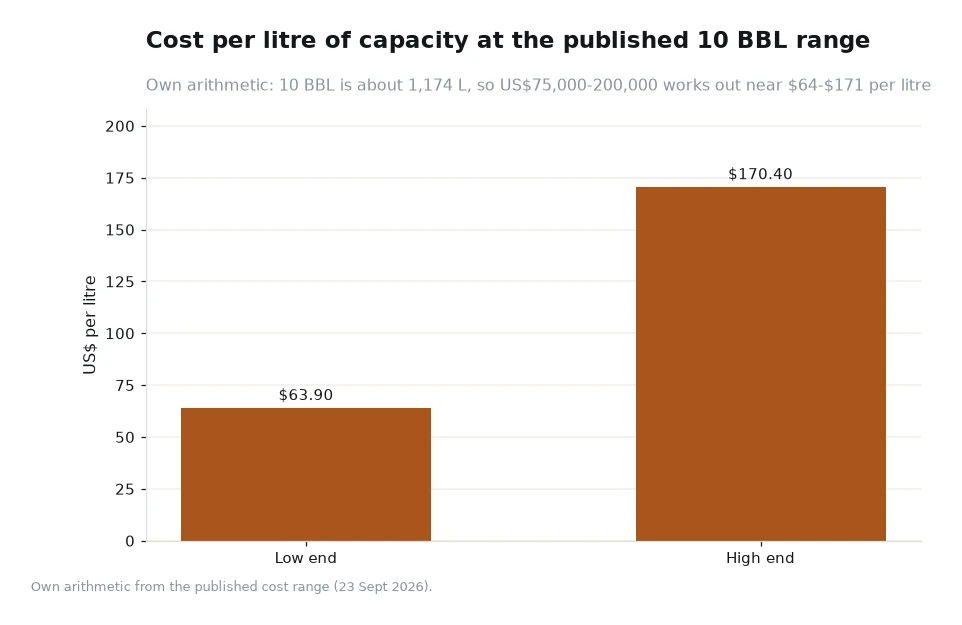
Finally, the cost side of the same table. Put the published range over the litres it buys — 75,000 / 1,174 = US$63.9 per litre at the bottom, 200,000 / 1,174 = US$170.4 at the top, and 7,500 to 20,000 per barrel — and you will notice that headspace and jacket layout appear nowhere in the arithmetic. That is why they are the details negotiated away first and regretted longest.
Frequently asked questions
Why does headspace matter on a fermentation tank?
Because krausen needs somewhere to go. The published design calculates cover headspace separately from the working volume, and a tank filled to the brim pushes foam through the CIP arm on the most active batch. On a 10 BBL tank of about 1,174 L, a 20% cover leaves about 235 L of room and a 25% cover about 294 L.
What do jackets on the body and the cone change?
They let the whole vessel move temperature together rather than the shell alone, so the cone where the yeast settles is not waiting on the body to cool down. The published design uses specially designed jackets on both the body and the cone, and the jacket pressure test is one of the five inspection steps recorded for every shipment.
Ask Three Questions of Any Tank Quote
Ask where the jackets sit and what the cone does, ask for the cover headspace in litres, and ask for the weld and polishing standard in writing. Those three answers separate two tanks that look identical in a photograph, and none of them is a matter of opinion.
The brewery-system pages show how the tanks sit inside a complete package, the brewhouse pages cover the hot side that fills them, and the main site carries the published sizes from 100 L to 200 T and the 6-year warranty on tank accessories and electronic components against manufacturing defects.
Then connect the answers to the room: headspace and jacket design decide how a generation of beer behaves, but the floor drain, the glycol loop and the control panel decide whether the brewer can leave the site at the end of the day. Design the tank and the room together, and the first year of production stops being a series of surprises.
Published figures here come from the manufacturer's own website (hgmcbrewing.com), read 23 Sept 2026: the jacket layout, the separately calculated cover headspace, the TIG welding and 0.4 micrometre polishing standard, the 304 and 316 plate thicknesses, the SGS-certified SUS304 material, the 33 Plato design, the piping and control options, and the 6-year warranty on tank accessories and electronic components against manufacturing defects. Volumes and cost-per-litre figures are the author's own arithmetic.[1]