The question "how long does it take" has no useful single answer, because the calendar is set by whichever stage cannot be compressed — and that stage is different for every project. In most first orders it is a component, not the perfume. Buyers who identify the critical path early can often shorten a project by weeks without asking anyone to work faster.
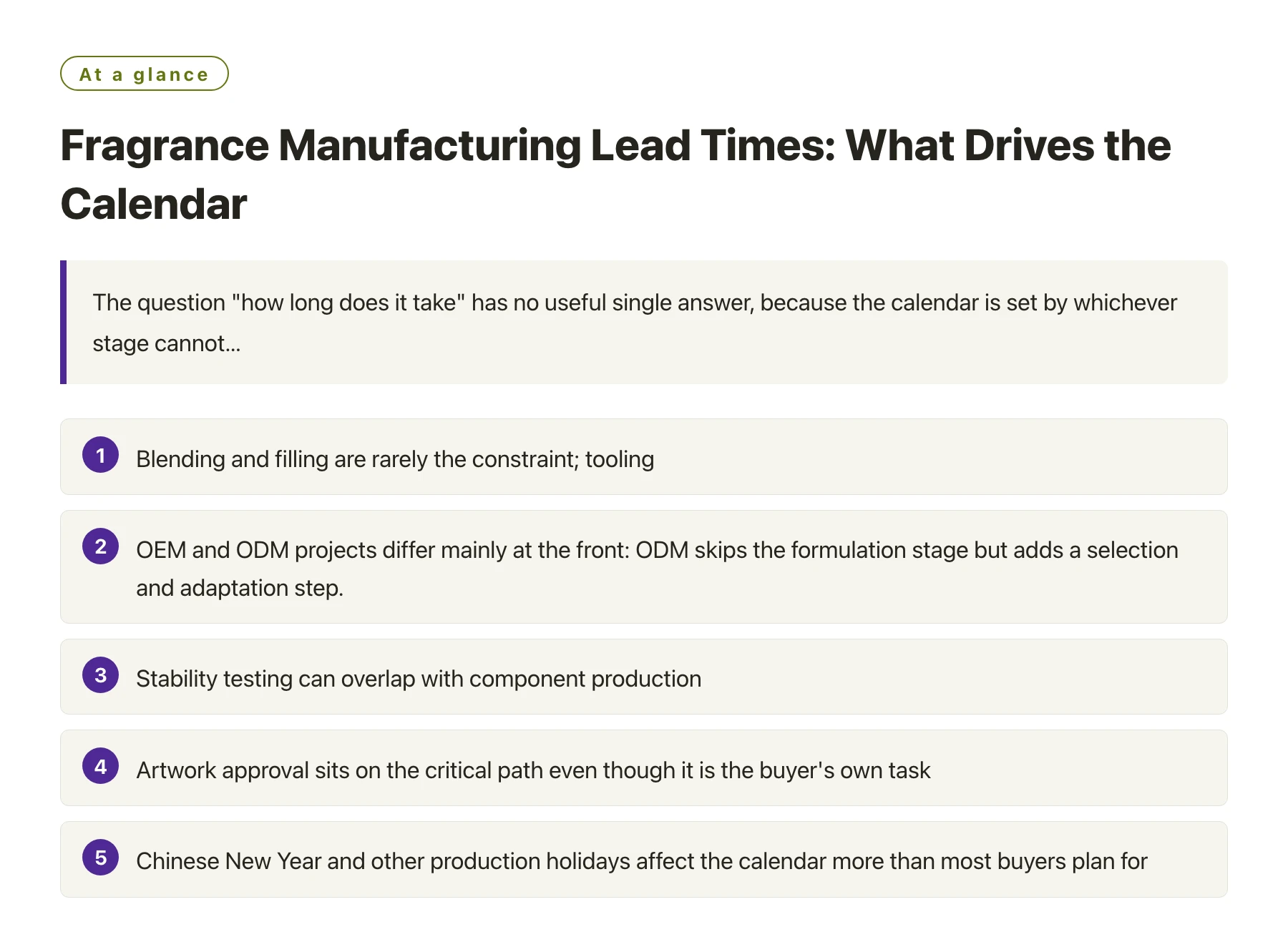
Key takeawaysBlending and filling are rarely the constraint; tooling, component production and stability testing usually are. · OEM and ODM projects differ mainly at the front: ODM skips the formulation stage but adds a selection and adaptation step. · Stability testing can overlap with component production, which is the single most effective schedule compression available. · Artwork approval sits on the critical path even though it is the buyer's own task, and it is the delay most often self-inflicted. · Chinese New Year and other production holidays affect the calendar more than most buyers plan for, particularly for components.
Lead time in this industry is a sum of parallel and sequential stages, and the only number worth committing to is the length of the longest chain. That is why two projects with the same supplier and the same order quantity can differ by two months.
This breakdown is written for a brand planning a launch date and deciding how much buffer to hold.
The stages, and which ones can run at the same time
Every project contains some version of the same sequence: brief, sample, approval, component sourcing, stability check, bulk blending, filling, packing and documentation. The sequence is fixed; the overlap is not, and overlap is where the schedule is won or lost.
The chart below shows the typical dependency, with the stages that can usually be run in parallel marked as such.
Stage dependencies
| Stage | Depends on | Can overlap with |
|---|---|---|
| Brief and feasibility | Brand's specification | Nothing; it is the gate |
| Bench trial and sample | Approved brief | Component identification, artwork drafting |
| Sample approval | Physical sample received and tested | Component sourcing, if the spec is already fixed |
| Component production | Signed component specification | Stability testing, artwork approval |
| Stability and compatibility | Approved sample and intended pack | Component production |
| Bulk blending | Released raw materials and approved formula | Document preparation |
| Filling and assembly | Bulk and components both ready | Nothing; both inputs must exist |
| Release and packing | Batch test results | Freight booking |
Filling is the point where every parallel chain converges. If one input is late, the whole project waits there, which is why component production is the stage most worth tracking weekly. When suppliers describe their production capacity and lead times, the stage breakdown is the part worth comparing line by line. A quality system built around a cosmetics GMP framework such as ISO 22716 also affects the calendar, because incoming material checks and batch records are scheduled work rather than paperwork done afterwards [1].
How OEM and ODM differ on the calendar
An OEM project starts with a formula the brand brings, so the front of the schedule includes a technical review and a production trial rather than a development phase. That is not automatically faster: a formula that has to be adjusted for the intended dosage or for a restricted material can consume the same weeks that an ODM project would spend selecting a base. The use-level standards that drive those adjustments are published and searchable, and formulators treat them as a design constraint rather than a final audit [2].
An ODM project starts from an existing base, which removes development time but adds a selection and adaptation step. In practice, ODM reaches a first sample sooner and OEM reaches a production-ready specification with more confidence, because the formula has already been built around the brand's intent.
What compresses the calendar
Three levers reliably shorten a project: starting stability work as soon as the sample is approved, choosing a standard closure rather than a new tool, and having the artwork ready before the sample round ends. A manufacturer that offers both OEM and ODM fragrance production can often start component sourcing in parallel with the second sample round, which is a real saving rather than a promise.
What extends it
New tooling for a bottle or cap is the largest single addition and is usually measured in weeks rather than days. A late change to the concentrate after artwork has been printed is the second, because it can invalidate the stability work and the label at the same time. Freight mode is the third: sea freight is cheaper and slower, and the decision is usually reversible only at a cost. Working with a perfume production partner in China that quotes the tooling line explicitly makes it easier to see which of these three is actually driving your date.
Building a launch date that survives contact
A launch date should be set from the critical path backwards, with the buffer attached to the stage you do not control. For most brands that is component production; for some it is the retailer's listing deadline, which is fixed and non-negotiable.
Two calendar facts are worth marking on the plan. The first is the production holiday period in the manufacturing region, which affects component suppliers and freight forwarders as well as the factory. The second is the stability period itself, which cannot be shortened by paying more; a compressed stability check is not a check.
Ask for the lead time by stage
A supplier that answers "about sixty days" has told you nothing you can plan against. Ask for the stage breakdown, then ask which stage is on the critical path for your specific components. Two suppliers may quote the same total for very different reasons, and only one of those reasons may apply to your project.
Decide what can be sacrificed
If the date is fixed and the schedule slips, something has to give: a bespoke component becomes a standard one, a decorated carton becomes a plain one, or sea freight becomes air. Deciding the order of those trade-offs before the delay happens is the difference between a controlled compromise and a panicked one.
Sources
- SGS: Cosmetics, Personal Care & Household Testing —— Testing, inspection and certification services for cosmetics and personal care, including microbiological, stability and safety testing aligned with cosmetics GMP.
- IFRA Standards Library (International Fragrance Association) —— The IFRA Standards Library lists the restrictions the fragrance industry applies to individual fragrance ingredients, based on safety assessments; it is the reference point for compliant fragrance formulation.
Frequently asked questions
What is a realistic lead time for a first fragrance order?
It varies too much for a single figure to be useful. What matters is the split: identify which stage is longest for your specific components and packaging, and build the launch date from there with buffer on the stages you do not control.
Is ODM faster than OEM?
Usually at the first sample stage, because the base already exists. The gap narrows or reverses if the OEM formula needs adjustment for the intended dosage or for a restricted material, since that work resembles a development cycle.
Can stability testing be shortened?
It can be run in parallel with component production, which saves calendar time, but the test itself should not be compressed. A shortened check defeats the purpose of running it.
How much buffer should I add to a launch plan?
Enough to absorb a delay in the stage you least control. For most first projects that means component production, and the buffer is usually measured in weeks rather than days.
Do production holidays really affect the schedule?
Yes, and they affect component suppliers and freight forwarders as well as the filling factory, so the effect is wider than the factory closure itself. Mark the period on the plan and confirm the cut-off dates with each supplier.