Edge Sealing and Site Handling: Extending Panel Service Life
Formwork panels seldom wear out across the face; they fail at the edge, where water reaches the core before the surface has taken any real damage. Published reuse guidance for high-grade boards runs to 10–20 concrete pours, and most of that budget is spent by the third pour if edges are left open and panels are levered apart with a bar.

Key takeaways
- Sealed edges keep water out of the core between pours — the single biggest factor in reaching the published 10–20 cycle range.
- Thickness guidance is 18 mm for heavy formwork and 21 mm and above for bridges and high-load platforms.
- Film weight sets the finish: 165 g/㎡ on smooth surfaces, 130 g/㎡ as the lighter option.
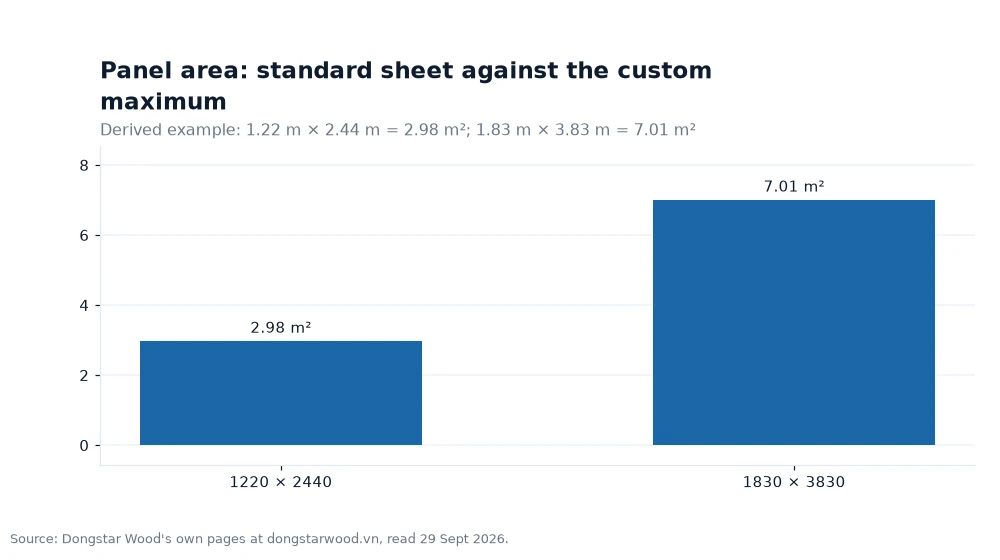
- Sheet area starts at 1.22 × 2.44 m gives 2.98 m² and reaches 1.83 m × 3.83 m = 7.01 m² a sheet at the custom maximum.
Why the edge decides how long a board lasts
A panel is a stack of veneers bonded under heat and pressure, and the faces are protected by film while the edges are cut veneer. Water enters there first. Once it does, the outer plies swell, the bond line is stressed from the inside, and the next time the panel is stripped the film lifts at a corner rather than releasing across the whole face.
Sealing is the least costly maintenance on a site. Sealing cut edges and any trimmed corners with a compatible paint or sealant closes the path that moisture follows, and panels that are sealed re-enter service flat instead of cupped. Manufacturers publish sealed edges as part of the specification for exactly this reason.
Cleaning and release agent between pours
The face has to come away clean, and that depends on what is done before the pour rather than after it. A release agent applied evenly gives a repeatable surface; a patchy coat leaves concrete stuck to the board, and scraping it off costs a layer of film every time.
Release agent is not the same product as a curing compound, and mixing the two is a common cause of a cloudy face. A thin, even film of the right agent is what the surface needs; a heavy coat leaves a residue that shows up as a patchy finish on the concrete itself and is then blamed on the panel.
Clean between pours, not at the end of the project. Concrete residue left on the surface hardens over a night and pulls film off at the next strip. A stiff brush and water on a sealed edge take a few minutes on the bench and save a panel from being retired at the fifth pour.
Stacking, storage and the moisture argument
Flat stacks on bearers, out of standing water, keep panels true. Stored on edge without support, a 2,500 mm board will creep and the next pour shows the curve, so the storage decision is really a flatness decision.
The stacking rule also settles who owns damage. If panels are delivered flat on pallets and then stored on edge against a fence, no one can tell whether a bowed sheet arrived that way or was bent on site. Photograph the stack on arrival and again before the first pour, and the argument disappears.
Heat matters as well as water. Panels left against a sun-facing wall in summer reach surface temperatures that soften the release layer, so shade is worth as much as shelter when a stack has to sit outside for weeks.
Sites that store panels outdoors in a wet month should expect the face to stay sound and the edges to work harder. That is an argument for the sealed specification and, where the board is out in the open for weeks at a time, for the heavier film weight rather than the lighter one.
Matching thickness and format to the pour
The published thickness guidance is short: 18 mm handles the majority of heavy formwork, and 21 mm or more is specified where bridges and high-load platforms are involved. Formats run from the 1220 × 2440 mm sheet through 1250 × 2500 mm to 1500 × 3000 mm, and bespoke sizes top out at 1830 × 3830 mm.
Ordering a Film Faced Plywood panel against a pour schedule comes down to keeping three numbers straight: sheet size in millimetres, thickness, and film weight. Get those onto the order and the handling conversation on site becomes a checklist rather than a debate.
Large panels reduce the number of joints and therefore the number of edges exposed to water, which is why the custom maximum is used on walls where a joint-free finish matters. The trade-off is handling weight, so the only sensible way to choose is to count the joints the site is willing to seal.
| Item | Published value | Site consequence |
|---|---|---|
| Reuse guidance | 10–20 cycles | Depends on sealed edges and cleaning |
| Smooth surface film | 165 g/㎡ | Fair-faced concrete, longer wear |
| Lighter film | 130 g/㎡ | Economical where a finish is added later |
| Heavy-use thickness | 18 mm, 21 mm and above | Deflection under wet concrete |
What a formwork plywood specification should name
Two lines are missing from most site specifications. The first is the adhesive: WBP or Phenolic Dynea belongs on the drawing where panels meet water repeatedly, and E0 or E1 emission classes belong in the file where interior exposure is involved. The second is the surface: a phenolic film is the standard choice for release, and it is worth stating the film weight instead of leaving it to the supplier.
Training costs nothing and shows up in the reuse figure. Two sentences to a site team — seal every cut edge, never prise a panel off at the corner — routinely add pours to the life of a deck, and they are cheaper than the replacement sheets they avoid.
Write the handling rules next to the specification. Reseal edges after trimming, stack flat on bearers, clean between pours and never lever a panel off with a bar. Those four sentences are usually enough to move a panel programme from the bottom of the reuse range towards the top.
Worked example: contact area from one sealed panel
Take a 1250 × 2500 mm board: 1.25 × 2.5 m gives 3.125 m² of contact face per pour. At the published low end, one panel delivers 10 × 3.125 m² = 31.25 m² of formwork contact over its life (example).
At the top of the range the same sheet gives 20 × 3.125 m² = 62.5 m² (example). A 900 m² slab poured in one go needs 900 ÷ 3.125 = 288 sheets (example), but if the panels are resealed between pours and reused five times, the deck requirement falls to 900 ÷ (3.125 × 5) = 58 sheets per cycle (example).
Frequently asked questions
How often should edges be resealed?
After every trim and at the start of a reuse cycle. A cut edge has no film and no sealer, so it behaves like an open wick until it is painted. On long programmes, a five-minute job on the bench is cheaper than replacing panels mid-project.
Which film weight suits a site that leaves panels outdoors?
The 165 g/㎡ smooth film, which is the heavier of the two published options. The 130 g/㎡ film is the economical choice where the concrete will be rendered or clad, and it is best kept for work with short exposure and a dry storage routine.
Does a thicker panel reduce edge sealing work?
It reduces joints rather than edges. A 21 mm panel deflects less under wet concrete, so fewer props and fewer panel joints are needed, but every edge that does exist still has to be sealed before the pour.
Where the specification sheets help
Compare the handling notes with what the mill publishes: the economical black film option is the right comparison where a shorter reuse cycle is acceptable, while the company's own pages set out the factory area, line count and certificate list behind both.
Reuse cycles, film weights and formats come from the manufacturer's own website, as checked on 29 Sept 2026 for the data in this article for the data in this article and used throughout this guide[1].